


Welcome to Free Ebook Engineering http://freebooks-me.blogspot.com!
Showing posts with label Renewable. Show all posts
Showing posts with label Renewable. Show all posts
Optimum Design of Renewable
BY Anonymous
0 COMMENTS
0 COMMENTS

Control of global warming is a common subject in the world. Therefore, the challengers of various fields
are considering methods to control global warming. Microgrid technology is expected as a next-generation energy supply system. However, since renewable energy is unstable, in many cases, it requires support by the conventional energy equipment. We are investigating the compound energy system from the following two viewpoints. One is the development of highly efficient energy storage equipment represented by a battery and heat-storage tank. Another is development of the operation optimization technology of the compound energy system including green energy. It is thought that the energy supply method shifts from the individual operation of large-scale plant to distribution of small equipment or microgrid. Moreover, a microgrid develops into a smart-grid by various added values with IT technology.
On the other hand, it was predicted that the reduction technology of the greenhouse gas of a microgrid
progressed sharply, and we named the nature-grid. A microgrid, a smart grid, and a nature-grid require
fusion of energy technology and an information technology. For example, the operation in consideration of the green energy change with load prediction and weather prediction of a compound energy systemcan be planned. This book describes the operation optimization technology by compound utilization of a PEFC, PEFC-SOFC combined system, bio-ethanol solar reforming, wind-power generation, woody biomass engine, city-gas engine, diesel power plant, etc. The technology described in this book plays a large role in the development of a small-scale power-generation system, a microgrid, a smart-grid, and a nature-grid, which are introduced into individual houses, apartment houses or local area power supplies.
The book is organized into twelve chapters. A brief description of each of the chapters follows:
Chapter 1 has described operating schedule of a combined energy network system. In the 1st section, the chromosome model showing system operation pattern is applied to GA (genetic algorithm), and the method of optimization operation planning of energy system is developed. The optimization method of this operation planning was applied to the compound system of methanol steam reforming type fuel cell, geo-thermal heat pump and the electrolysis tank of water. The operation planning was performe for the energy system using the energy demand pattern of the individual residence of Sapporo in Japan.
From analysis results, the amount of outputs of a solar module and the relation of the operation cost of the system which are changed by the weather were clarified. In the 2nd section, reduction in fuel cell
capacity linked to a fuel cell network system is considered. An optimization plan is made to minimize the quantity of heat release of the hot water piping that connects each building. Such an energy network is analyzed assuming connection of individual houses, a hospital, a hotel, a convenience store, an office building, and a factory. Consequently, a reduction of 46% of fuel cell capacity is expected compared with the conventional system in the case study.
download link:
http://cutt.us/BBWcz
or
http://cutt.us/95EmH

Solar Power for Your Home David S. Findley
BY Anonymous
0 COMMENTS
0 COMMENTS

1 The History of Solar Energy
Sunlight and Life on Earth
The Human Factor
The Future
Food Production and Declining Natural Resources
Desertification
Solar for Humanity
2 The Benefits and Detriments of Solar Energy
The Solar Power Convergence
Types of Solar Power
Other Forms of Energy
Wind Power
Geothermal Energy
Tidal Energy
Ultimate Benefits of Solar Energy
Challenges of Solar Energy
3 Types of Solar Energy
Energy and Oil
Passive Solar
Concentrated Solar Power
CSP with Parabolic Mirrors
Stirling Engine
Solar Water Heaters
Updraft Solar
Concentrating PV Solar
Types and Benefits of PV Solar
Thin-Film Solar
Focused-Lens and Specialty PV
Solar Costs
4 Energy-Efficient Home Systems
Remove and Replace Appliances
Washing Machines
Clothes Dryers
Small Appliances
Hot Water Heaters
Solar Water Heater
Tankless Water Heater
Heat Pump
Gas Condensing Hot Water Heater
High-Efficiency Gas Storage Water Heater
Cooling Systems
Room Air Conditioners
Central Air Conditioning
Heating Systems
Geothermal Energy vs. Ground Geothermal
Maintaining Home Heating and Cooling Systems
What to Look For in a New Heating System
Other Large Energy Consumers
5 Zero-Cost Passive Solar
Passive Solar Homes
The Big and Small Pictures
Building a Passive Solar Home
Passive Solar Home Modifications
Good Solar Design
Types of Solar Gain
Simple Improvements for Solar Gain
Landscaping
Fun with Passive Solar
Solar Oven
Solar Clothes Dryer
Solar Water Purification
Passive Solar Cooling
Gardening
6 Creating a Personal Energy Plan
Creating a Home Energy Plan
Evaluating Your Home Energy Use
How to Use the Plan
What to Include in a Complete Energy Plan
Making the Most of Your Plan by Changing Old Habits
7 The Fundamentals of a PV System
PV System Components
How PV Cells Work
Solar Cells and Panels
Single, or Monocrystalline, Silicon Panels
Polycrystalline, or Multicrystalline, Silicon Panels
Amorphous Silicon or Thin-Film Panels
Group III and V Technologies
Building-Integrated Photovoltaic
Concentrated Solar Power
High-Efficiency Multijunction Devices
Solar Panel Efficiency
The Inverter
Electrical Meters
Solar Tracking System
PV Energy Production and Savings
How Much Does a Typical PV System Cost?
Rebate and Deduction Caveats
Warranties and Replacement Costs
Payback Time
8 Solar Projects You Can Use Today
Solar-Powered Swimming Pool
Solar Lighting
Solar Pet Home
Flexible Solar-Powered Gear
Solar Oven
Electric Lawnmower
Solar Carport
9 The Real Costs of Energy Consumption
Global Warming
CO2, You, and the World
Reduce Your Carbon Footprint
10 How and When to Hire a Contractor
Planning Your Solar Renovation
Hire an Architect
Know Your Budget
Choose the Right Contractor
Interviewing Contractors
Things to Notice During the Interview
Licensing
Getting Estimates
Building Contracts
Payments
Permits
What to Do If Things Go Bad
11 Funding Your Solar Project
Savings
And Loans
Bank Loans
Contractor Loans
Credit Cards
FHA and HUD Loans
State-Funded Loans
Home Equity Loans
Mortgage Refinancing
Rebates, Tax Incentives, and Tax Credits
Tax Rebates
Tax Credits
Grants
Selling Power Back to the Grid
12 The Future of Solar Energy
Thin-Film Solar
Micro Solar
Nano Solar
Light-Spectrum Technologies
Hybrid Technologies
Electrical Grid
Hydrogen Fuel Cells
Battery Backup
Storage Systems
The Promise of the Future
Appendix: Standards, Conversions, and Green References
download link:
http://cutt.us/QGCZJ
or
http://cutt.us/GODYq
Integration of Green and Renewable Energy in Electric Power Systems
BY Anonymous
0 COMMENTS
0 COMMENTS

A practical, application-oriented text that presents analytical results for the better modeling and control of power converters in the integration of green energy in electric power systemsThe combined technology of power semiconductor switching devices, pulse width modulation algorithms, and control theories are being further developed along with the performance improvement of power semiconductors and microprocessors so that more efficient, reliable, and cheaper electric energy conversion can be achieved within the next decade. Integration of Green and Renewable Energy in Electric Power Systems covers the principles, analysis, and synthesis of closed loop control of pulse width modulated converters in power electronics systems, with special application emphasis on distributed generation systems and uninterruptible power supplies.The authors present two versions of a documented simulation test bed for homework problems and projects based on Matlab/Simulink, designed to help readers understand the content through simulations. The first consists of a number of problems and projects for classroom teaching convenience and learning. The second is based on the most recent work in control of power converters for the research of practicing engineers and industry researchers.Addresses a combination of the latest developments in control technology of pulse width modulation algorithms and digital control methodsProblems and projects have detailed mathematical modeling, control design, solution steps, and resultsUses a significant number of tables, circuit and block diagrams, and waveform plots with well-designed, class-tested problems/solutions and projects designed for the best teaching-learning interactionProvides computer simulation programs as examples for ease of understanding and platforms for the projectsCovering major power-conversion applications that help professionals from a variety of industries, Integration of Green and Renewable Energy in Electric Power Systems provides practical, application-oriented system analysis and synthesis that is instructional and inspiring for practicing electrical engineers and researchers as well as undergraduate and graduate students.
A practical, application-oriented text that presents analytical results for the better modeling and control of power converters in the integration of green energy in electric power systems
The combined technology of power semiconductor switching devices, pulse width modulation algorithms, and control theories are being further developed along with the performance improvement of power semiconductors and microprocessors so that more efficient, reliable, and cheaper electric energy conversion can be achieved within the next decade. Integration of Green and Renewable Energy in Electric Power Systems covers the principles, analysis, and synthesis of closed loop control of pulse width modulated converters in power electronics systems, with special application emphasis on distributed generation systems and uninterruptible power supplies.
The authors present two versions of a documented simulation test bed for homework problems and projects based on Matlab/Simulink, designed to help readers understand the content through simulations. The first consists of a number of problems and projects for classroom teaching convenience and learning. The second is based on the most recent work in control of power converters for the research of practicing engineers and industry researchers.
Addresses a combination of the latest developments in control technology of pulse width modulation algorithms and digital control methods
Problems and projects have detailed mathematical modeling, control design, solution steps, and results
Uses a significant number of tables, circuit and block diagrams, and waveform plots with well-designed, class-tested problems/solutions and projects designed for the best teaching-learning interaction
Provides computer simulation programs as examples for ease of understanding and platforms for the projects
Covering major power-conversion applications that help professionals from a variety of industries, Integration of Green and Renewable Energy in Electric Power Systems provides practical, application-oriented system analysis and synthesis that is instructional and inspiring for practicing electrical engineers and researchers as well as undergraduate and graduate students.Content:
Chapter 1 Smart Grid Distributed Generation Systems (pages 1–25):
Chapter 2 Inverter Control Voltage and Current in Distributed Generation Systems (pages 26–70):
Chapter 3 Parallel Operation of Inverters in Distributed Generation Systems (pages 71–104):
Chapter 4 Power Converter Topologies for Distributed Generation Systems (pages 105–118):
Chapter 5 Voltage and Current Control of a Three?Phase Four?Wire Distributed Generation (DG) Inverter in Island Mode (pages 119–178):
Chapter 6 Power Flow Control of a Single Distributed Generation Unit (pages 179–202):
Chapter 7 Robust Stability Analysis of Voltage and Current Control for Distributed Generation Systems (pages 203–223):
Chapter 8 PWM Rectifier Control for Three?Phase Distributed Generation System (pages 224–233):
Chapter 9 Matlab Simulink Simulation Testbed (pages 234–249):
The combined technology of power semiconductor switching devices, pulse width modulation algorithms, and control theories are being further developed along with the performance improvement of power semiconductors and microprocessors so that more efficient, reliable, and cheaper electric energy conversion can be achieved within the next decade. Integration of Green and Renewable Energy in Electric Power Systems covers the principles, analysis, and synthesis of closed loop control of pulse width modulated converters in power electronics systems, with special application emphasis on distributed generation systems and uninterruptible power supplies.
The authors present two versions of a documented simulation test bed for homework problems and projects based on Matlab/Simulink, designed to help readers understand the content through simulations. The first consists of a number of problems and projects for classroom teaching convenience and learning. The second is based on the most recent work in control of power converters for the research of practicing engineers and industry researchers.
Addresses a combination of the latest developments in control technology of pulse width modulation algorithms and digital control methods
Problems and projects have detailed mathematical modeling, control design, solution steps, and results
Uses a significant number of tables, circuit and block diagrams, and waveform plots with well-designed, class-tested problems/solutions and projects designed for the best teaching-learning interaction
Provides computer simulation programs as examples for ease of understanding and platforms for the projects
Covering major power-conversion applications that help professionals from a variety of industries, Integration of Green and Renewable Energy in Electric Power Systems provides practical, application-oriented system analysis and synthesis that is instructional and inspiring for practicing electrical engineers and researchers as well as undergraduate and graduate students.Content:
Chapter 1 Smart Grid Distributed Generation Systems (pages 1–25):
Chapter 2 Inverter Control Voltage and Current in Distributed Generation Systems (pages 26–70):
Chapter 3 Parallel Operation of Inverters in Distributed Generation Systems (pages 71–104):
Chapter 4 Power Converter Topologies for Distributed Generation Systems (pages 105–118):
Chapter 5 Voltage and Current Control of a Three?Phase Four?Wire Distributed Generation (DG) Inverter in Island Mode (pages 119–178):
Chapter 6 Power Flow Control of a Single Distributed Generation Unit (pages 179–202):
Chapter 7 Robust Stability Analysis of Voltage and Current Control for Distributed Generation Systems (pages 203–223):
Chapter 8 PWM Rectifier Control for Three?Phase Distributed Generation System (pages 224–233):
Chapter 9 Matlab Simulink Simulation Testbed (pages 234–249):
Download
or
http://cutt.us/Ha218w
Hybrid Hydrogen Systems
BY Anonymous
0 COMMENTS
0 COMMENTS

Renewable energy technologies have been used on a small scale for many years now. Issues of intermittency and cost have prevented their widespread use and acceptance. At present, discussion and research is aimed at moving the current global fossil fuels economy to one based on hydrogen as the universal energy carrier, with fuel cells as a means of converting this chemical energy to electrical energy.
Hybrid Hydrogen Systems presents an original and comprehensive approach to hybrid energy system optimization, providing a much-needed systems approach to hydrogen energy applications. This book provides a comprehensive overview of the fundamentals of renewable power generation, conversion and storage, including:
wind,solar photovoltaic power,biomass,batteries,fuel cells, andhydrogen.
As well as proposing a unique approach to minimize the cost and maximize the reliability of hybrid energy systems, Hybrid Hydrogen Systems introduces the benefits of hydrogen as an energy carrier in the context of sustainability.
This book will be of interest to researchers and practitioners working with hydrogen and fuel cells, as well as to policy makers and advocates of renewable energy. Hybrid Hydrogen Systems will also be a valuable tool for graduate and advanced undergraduate students studying renewable energy and the design and optimization of hydrogen energy systems, as well as for the lecturers who teach these subjects.
download link:
here
or
http://cutt.us/ErWCA
Mirror
download
Megatrends for Energy Efficiency and Renewable Energy
BY Anonymous
0 COMMENTS
0 COMMENTS

The use of energy is being shaped by environmental issues including the fear of global warming. This has resulted in the development of renewable energy sources and more efficient building technology. Examining trends in energy efficiency, this book explores energy technologies and fuels, their prospects in a world with greenhouse gas restrictions. It looks at the technical and economic tradeoffs of traditional renewables such as wind and solar, as well as large scale PV and concentrated thermal power. It also considers biomass technologies. For each of these technologies, it discusses planning, siting, installation, operation and maintenance, health and safety, power conditioning, and efficiency innovations.
download link:http://cutt.us/L3wXw
or
http://cutt.us/ujJz
Wind Energy - Fundamentals, Resource Analysis and Economics
BY Anonymous
0 COMMENTS
0 COMMENTS

Growing energy demand and environmental consciousness have re-evoked human interest in wind energy. As a result, wind is the fastest growing energy source in the world today. Policy frame works and action plans have already been for- lated at various corners for meeting at least 20 per cent of the global energy - mand with new-renewables by 2010, among which wind is going to be the major player. In view of the rapid growth of wind industry, Universities, all around the world, have given due emphasis to wind energy technology in their undergraduate and graduate curriculum. These academic programmes attract students from diver- fied backgrounds, ranging from social science to engineering and technology. Fundamentals of wind energy conversion, which is discussed in the preliminary chapters of this book, have these students as the target group. Advanced resource analysis tools derived and applied are beneficial to academics and researchers working in this area. The Wind Energy Resource Analysis (WERA) software, provided with the book, is an effective tool for wind energy practitioners for - sessing the energy potential and simulating turbine performance at prospective sites.
Table of contents : Introduction....Pages 1-9
Basics of wind energy conversion....Pages 11-43
Analysis of wind regimes....Pages 45-88
Wind energy conversion systems....Pages 89-143
Performance of wind energy conversion systems....Pages 145-178
Wind energy and environment....Pages 179-207
Economics of wind energy....Pages 209-236
download link:Basics of wind energy conversion....Pages 11-43
Analysis of wind regimes....Pages 45-88
Wind energy conversion systems....Pages 89-143
Performance of wind energy conversion systems....Pages 145-178
Wind energy and environment....Pages 179-207
Economics of wind energy....Pages 209-236
http://cutt.us/PeQhp
or
http://cutt.us/SCg0Y
100 Per Cent Renewable - Energy Autonomy in Action - Peter Droege (Earthscan, 2009)
BY Anonymous
0 COMMENTS
0 COMMENTS

The time has come to abolish the combustion of coal, oil and gas for energy generation worldwide, along with the nuclear power threat. This is the historical challenge of today. It is unlike any other that receded it in the emergence of human civilization. It is unprecedented because it involves a collective choice to be made across a wide array of technological, social and economic conditions to go beyond the slow and messy process of blind evolution. A global renewable energy base is the very foundation of sustainable life on this planet. Only with it, massive afforestation efforts and lifestyle changes to higher quality and dramatically lowered material consumption become the essential elements of hope. A worldwide move to sustainable economic practice beyond green lip service may just still carry this promise: to rebuild the inherited system of wasteful abundance for the few into a basis for sustaining human life in a steady-state economy for all.
100 per cent renewable means an entirely renewable power base for the global economy, across the lifecycle of energy flows, embodied, operational, transport or stationary. In this world steeped in expensive and toxic hydrocarbon fuels and products it does not seem easy for anyone but isolated indigenous tribes to live up to this ideal. Nevertheless, the aim to rely on the abundant and largely free sources of the sun is clear, and it is necessary. A wave of innovations rises in infrastructure systems, personal transport or community development, successfully procuring non-polluting local electricity and thermal resources. Manufacturers begin to develop renewable production processes, and increasingly, producers of closed-cycle materials are keen on eliminating fossil carbon combustion content. This book is a snapshot of a dynamic picture, a world well on the path to sustaining human civilization on a renewable planet.
Is 100 per cent too ambitious? Climate change and fossil fuel production risks are now so massive that an anthropogenic carbon emissions balance has to be aimed at that is significantly below zero: current atmospheric carbon dioxide (CO2) concentrations will have to be lowered by at least 25 per cent through carbon sequestration in forests and soils to eventually return to preindustrial levels that is, if a choice is to be made to actively and purposefully compensate for human damage. Others may prefer to pray instead for helpful disasters : such as, say, the collapse of the Gulf Stream to slow Greenland glacial melting.
How to get there? The path is different for each person, community, company or country. For some, internal renewable resources can be maximized more easily, for others, regional and national programmes will have to be the more powerful agenda carriers. Weak local government will require strong action by state and national institutions. Developing countries in the grip of international lending leveraged policies will also benefit from a reform of these policies, to advance 100 per cent renewable targets not merely as desirable aspects of sustainable development, but the very condition on which to found sustainable aims such as, for example, the Millennium Development Goals
(MDGs).
download link
http://cutt.us/qp2x
or
http://cutt.us/GZ0p3
Renewable energy systems by just sea water or salt table
BY Anonymous
0 COMMENTS
0 COMMENTS
Experiments with homemade batteries
Note: for details of talks and workshops on this topic click here:
talks and workshops
Summary
Simple homemade batteries are described that can be made from items found in the home or school lab. These experiments help students/pupils understand how to wire them up, the origin of current, voltage and power, as well as of course the chemistry that drives the batteries. There is ample scope here for school/home project investigations, experimentation and innovation.
Introduction
The modern battery is found in high-tech applications ranging from hearing aids and pace-makers to pocket calculators, personal stereos, radios and mobile phones. They are everywhere and completely invaluable. The origin of the power behind the battery is chemical. In the following article we explore some simple experiments involving homemade sea- water batteries that are not only instructive and fun to make, but which can be used to drive low-power devices.
The simplest cell (a battery is simply a group of cells) is made by putting two different metal electrodes into an electrolyte (usually a solution of a salt or acid in water). Each metal receives an electrical charge and one becomes more positive (+) than the other (-). Because opposites attract, there is an energy of attraction (called the voltage) between the charges, which is the origin of the battery's power (see below for a more full explanation of voltage, current, energy and power) of the battery.
A simple battery can be made by pushing a zinc-coated screw and a piece of copper into a lemon. This wonderfully simple cell can even produce enough power to run a LCD clock / watch and its worth experimenting with the cheap 'toy' watchs that are easy to find in markets. A carbon-rod electrode instead of the copper will also work. Three potatoes each having a carbon rod and a zinc-coated screw electrode system can be wired in series (like a daisy chain) to power an LED (Light Emitting Diode) light. Here we describe carbon rod and screw batteries using sea (salt) water as an electrolyte, which are made from household ice cube trays!
How they batteries work - electrolysis
The voltage created in a battery is due to ionic chemistry. When a metal electrode is immersed in an electrolyte a rather complex dynamic process occurs. Let us assume that the metal electrode is initially uncharged (the atoms from which the electrode is made are neutral - they have equal numbers of electrons and protons). When the metal is immersed in the electrolyte, positive metal ions are formed on the surface of the electrode. These ions pass into solution, making the electrode progressively more negative, as the positive ions move away. There will come a time, however, when the negatively charged electrode will start to attract back the oppositely charged ions. So a dynamic equilibrium is thus formed between those ions leaving and those returning to the metal surface. How far the equilibrium goes one way or the other is dependant on the reactivity of the metal.
A battery must have two electrodes, so meanwhile on the other electrode, a similar process must be taking place. If this second electrode is of the same metal as the first, then each electrode will charge to the same extent (voltage), and there will be no resulting difference between them. There will thus be no attractive force (electromotive force EMF) between them, and so no current will flow.
However, if the electrodes are of different metals, then their reactivity's will be different, and so different equilibria will be set up. One electrode will become charged to a greater extent than the other and because of the difference in reactivities will have a different voltage. In other words, there will now be a voltage difference between the electrodes. Because of this difference, electrons will want to move from one electrode to the other. This attractive potential is the voltage that we measure between the electrodes, and the origin of the batteries electrical power.
The Electrochemical Series
If we imagine a series of batteries, each made up of one metal electrode but each also having a 'standard electrode' (the standard that is used is an electrode composed of a platinum wire in a hydrogen gas envelope but we don't need to know much of the details here). We can draw up a table, called the Electrochemical Series, of the voltages arising from these different batteries. Such a table will be useful for comparing different electrode systems. We can actually use it to predict the voltage of a cell made up from two different metals (i.e. without the reference electrode). It is simply the difference between the two values of the standard electrode potentials (Note: it is important to keep in mind the sign + / - of these standard potentials when doing the calculation).
Voltage, current and power
As opposites attract, once the electrical circuit is completed, there will be a tendency for the negative electrons to be attracted to the more positively charged electrode. If a wire is connected between the two electrodes, this is precisely what happens. This potential energy (work that can be done) to move electrons when a circuit is conected is called the voltage of the battery:
V = Volts = energy per charge (joules / coulomb).
The amount of charge passing per unit time is known as the current:
A = Amp = rate of charge passing (coulombs / sec).
If we multiply the voltage between the electrodes by the particular current that is passing, we get the power of the cell:
P = Power = V x A = (joules / coulomb) x (coulombs / sec) = joules / sec
Which is the work done per time.
Battery efficiency
The voltage is dependant on the difference between the individual electrode potentials. However, in practice, this is only true in the ideal case where we can measure the voltage without drawing any appreciable current. This is the case when using a very high resistance voltmeter, but not the case when we use the battery to drive a radio, for example. In practice, what we find is that, as we start to draw current from the cell the voltage drops away.
This limitation of a real life battery is due to at least two factors; the nature of the electrolyte and the electrical resistance of the electrodes. The dependency of the battery voltage on the electrode potentials explains why similar results can be obtained using different electrolytes (eg.for example: Salt water, vinegar, sulphuric sulfuric acid, and even urine!). But of course the battery must also be dependant on the concentration and type of ions in the electrolyte. The limiting case being when there are no ions present at all (e.g. in a non ionic liquid or a battery that has dried out etc.).
Assuming that the electrolyte is above a threshold concentration the surface resistance of the electrodes then has to be considered. This is the electrical resistance made between the solid electrode and the solution due to the flow of electrons and ions. If the electrode resistances are low, the cell voltage will drop of slowly with rising current. If the resistance is high, the voltage will appear to drop as current is drawn from the battery. The internal resistance of cells is a major limiting factor in the application and usefulness of a real battery.
An experimental sea sea-water battery
We have seen how a pair of electrodes can produce a voltage when immersed in an electrolyte. In the following experiments we use of galvanised (zinc- plated) screws and carbon rods as the electrodes and salt water as the electrolyte. While carbon is a good conductor of electricity, the chemistry that takes place at the carbon electrode is more complicated than would be the case when simply using metals. However, larger potentials are produced with carbon and zinc than with copper and zinc, so it is worth the complication. Carbon is a good conductor of electricity. In these cells the metal (zinc) electrode is negative (-) while the carbon becomes positive (+).
To get round the limited voltage and current of such a simple cell, we can join up cells to make a battery of cells - thereby increasing the power. An effective arrangement is shown in the diagram Figure 1. Household ice- cube trays are used to hold the electrolyte, and wood supports the multiple pairs of electrodes, a set for each ice cube tray.
Making the battery
Each of the ice cube trays is 3/4 filled with a salt solution (sea water or a solution of table salt in water). Galvanised screws can be purchased from any hardware store. Pencil leads can be used for the carbon rods or, better still, they can be salvaged from carefully dismantled old ('flat') batteries. Then the electrode pairs are lowered into their respective ice cube tray solutions to create the 12 cells. They are then wired-up on the top side of the wooden support to form the battery.
Wiring the the cells up in series or parallel?
So what is the best way to wire up the 12 cells to get useful power from the battery? Consider a single cell; it can produce a voltage of V volts and a maximum current of say I amps. Wiring a number (n) of these cells in series (one after the other in a sort of daisy chain) will multiply the voltage giving n x V volts. However, the maximum current produced by this arrangement will be the same as that of a single cell - I. On the other hand wiring all the cells in parallel will increase the curent n-fold but maintain the voltage equivalent to that of a single cell (i.e. V). Combinations of series and parallel cells with produce combination of possible total V and I.
The ice cube tray used in these experiments had 12 compartments (ice cubes) and so to get useful power from the battery two combinations of wiring were chosen (see Figure 2): The first a) consists of two sets of six cells wired in series and these two sets then wired in parallel - giving a total of 6 x V and 2 x I. b) consisted of two sets of six parallel parallel cells which were wired in series - giving a total of 2 x V and 6 x I.

battery
Figure 1. two of the many possible circuit arrangements for making a battery from 12 sea water cells
Parts list:
Table 1) Salt (NaCl)
2) Ice- cube trays
3) Wood for electrode support
4) galvanised screws ( ca. 5 cm long) for each battery
5) 12 pencil leads (2B or softer), or better still, school lab carbon rods or ones salvaged from old worn out batteries
6) Tinned copper wire
battery
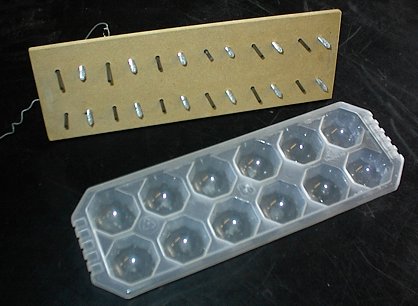
Figure 2. The multiple pairs of electrodes are shown attached to the wooden support. This is the 'high' voltage, 'low' current version. The ice cube trays hold the electrolyte for each cell. The cells are wired up above the board.
A sea water power plant (!)
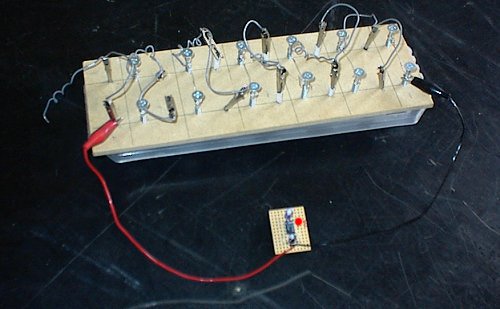
The first battery circuit provides a relatively higher voltage than the second and so it can therefore be used to power devises devices that need 'higher voltages' but low currents. A pocket LCD calculator, an LED (and series resistor), and possibly a pocket radio, will work well using this arrangement. In the demonstrations we use a simple flashing LED circuit to dramatically show the battery working. This circuit requires about 3V, but only about 1 or 2 mA to work.
Please Note: remember to check that the device you are powering is correctly wired to the � and + connection of the battery (metal (zinc) = -, carbon = +).
battery
Figure 3. The complete 'high' voltage, 'low' current sea water battery connected to an LED flasher circuit
The second battery circuit will work well on for devices that need a greater current but not a particularly high voltage. A good example of this would be a low voltage motor. Some motors will run on only about 1 volt but need 10 mA or so in order to turn (see notes section below for details of suitable motors).
Ideas for further experiments
The basic battery described above is capable of driving low power devices. As the battery is a device that converts chemical potential into electrical potential eventually the battery will fail (run down) as the chemistry develops at the electrodes and in the electrolyte. The zinc on the screws is dissolving and their may also be zinc hydroxide (and / or zinc chloride) forming on the electrodes which will increase the resistance. The electrodes will therefore need to be cleaned before each use of the battery to reduce the resistance and the chemical build up that inevitably occurs.
The obvious places for further experimentation are to try different electrode materials (what is the effect of the surface area of the electrodes for example) and try using different electrolytes (for example try orange juice, vinegar, sulphuric sulfuric acid, or even urine!). Does the current produced from the battery simply depend on electrolyte concentration or does it fail at some threshold value? What is the effect of the temperature of the electrolyte in the cells and if so why does it have an effect? Does this help to explain why you can rejuvenate used batteries by putting them on a warm radiator?
If you want the battery to start to work (to be activated) when immersed in sea water then try putting small pieces of sponge between the electrodes. When the empty battery is immersed, the sponges soak up sea water so that electrolyte remains between the electrodes when the battery is taken out. (If you leave the contraption in the sea many of the cells would be shorted out by the sea water - hence you need to take the battery out of the sea after the water gets in). This was the way we made the emergency life jacket lights in the fifth series of Rough Science set in Zanzibar (BBC2 Feb. 2005). When the life jacket went into the sea it activated the battery, powering the emergency lights.
The Baghdad Battery
In 1800 Count Alessandro Volta made what was thought to be the first device that we can consider as a modern day battery. He found from experiments that different metals in contact with each other via salt solution soaked strips created electricity. He made a device composed of an alternating pile of metal coins sandwiched between electrolyte (salt water) moistened felt strips. Connection to the two end of the pile allowed access to the voltage. This device became known as a 'voltaic pile' (historically this is where the terms volt and voltages got there names). In their modern form batteries are a recent invention although of course voltages have been present since the elements were formed and electrolytes could form and also in creatures such as electric eels etc. But was Volta's pile the first battery? There is however a rather controversial theory that batteries might have been around for more than 2000 years!
battery
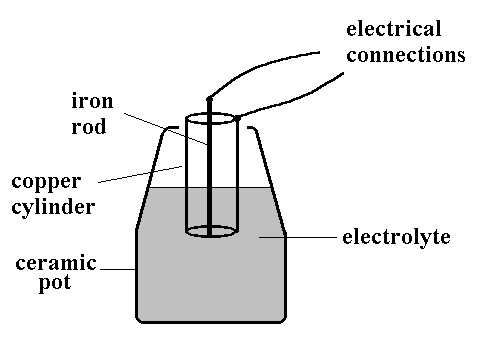
Figure 4. Schematic of the 200 BC Baghdad Battery composed of a ceramic pot, a copper cylinder, iron rod and vinegar electrolyte
In 1938 an archaeologist Von Wilhelm Konig working at the Baghdad Iraq Museum, claimed to have discovered a very old battery. He thought the Mesopotamians had invented the battery in 200 BC! ! His so-called 'Baghdad Battery', shown in the picture, consisted of a ceramic pot about 20cm high, in which was placed a cylinder of copper metal and an iron rod. It appears that the iron rod was surrounded by an oil/pitch based insulator, and evidence for organic material was found in the pot.
Recently we have made copies of these devices using vinegar (which of course would have been an available electrolyte at the time). A single device produces about 1V at 10mA. Of course from what we have learnt in this article such a system would indeed work as a battery, but was this the intention over 2000 years ago - did the Mesopotamians really mean to invent the battery, or did the device have some other, quite unconnected purpose?
It seems very un-likely that they purposely made a battery, especially as no wires were found with the device. However, assuming that they were using them as batteries, there are several theories that have been put forward for their purpose? One suggestion was that the Mesopotamians may have wired up many of the batteries so that they could electrify holy statues to give them 'magical' powers. This is a nice theory / idea perhaps, but electric shocks depend on high voltage, and they would have needed hundreds of batteries to produce a shock!
Another theory is that these small voltages could have been used in acupuncture (which had been discovered / invented by this time). Some of the devices batteries were found next to fine needles. It is possible that needles put in the skin and wired to a few volts might have produced therapeutic effects - well, some kind of effect anyway!
Finally in the course of our own recent investigations into Baghdad batteries, we tried to use the voltage from several batteries in series to drive a simple electrolysis reaction. The idea was to produce silver ions from a silver electrode (we used a silver bracelet), and use it to plate another (cheaper) metal electrode. Using silver and copper electrodes in a vinegar electrolyte we found (given enough time) that we could successfully silver (although not very nicely!) plate the copper using our set-up!
So, could the ancient Mesopotamians have used the similar Baghdad batteries to plate cheaper intricately designed copper statues with a silver layer? Unfortunately, no proof for this wonderfully appealing possibility exists in the archaeological records. The origin, use and purpose of the so called Baghdad batteries therefore still remains a mystery.
References
For details of the LED flashers click here
For details of the electrochemical series click here
For news articles about the Baghdad Batteries click here
For news articles about the Baghdad Batteries click here
Notes
1) We have found that 'carbon rods' are much better than 'graphite rods' of the same purity. Even though both types may be high purity carbon the 'carbon' rods appear to be more porous than the shinny graphite rods. The carbon rods therefore present a much greater surface area to the electrolyte. As a consequence the electrode resistance is much less, creating a better battery.
2) We made our first sea-water battery on in the very first series of Rough Science, and we have been hooked ever since! The batteries described here are regularly used in an electricity workshop we run at the CSC. In the fifth series of Rough Science (Zanzibar, Feb. 2005, BBC2) we used sea water batteries to power emergency lights on a life jacket.
3) It is worth checking the various companies that sell electronic component as most stock 'ultra bright' LED's as well as 'solar-cell' motors that work on very low voltages and currents suitable to be powered by these experimental batteries.
Acknowledgments
We would like to thank NESTA, the BBC and the Open University. In particular: David Shulman, Paul Manners, Mile Lehey and all the Rough Scientists (of all ages and countries). Many thanks to Graham Riley for valuable comments and also to Cicada films and Prof., Tony Ryan for work on the Baghdad Battery. We would like to dedicate this article to Jan Meering who taught at the Angmering School, West Sussex and all kids who went through our workshops there.
THE CREATIVE SCIENCE CENTRE


