


Welcome to Free Ebook Engineering http://freebooks-me.blogspot.com!
Showing posts with label Concrete Technology. Show all posts
Showing posts with label Concrete Technology. Show all posts
Handbook of Analytical Techniques in Concrete Sciences and Technology by V.S.Ramachandran and James J.Beaudoin Free Download PDF
Sunday, February 14, 2016
IN
analytical techniques
,
beaudoin
,
Concrete Technology
,
download pdf
,
free
,
ndt techniques
,
petrographic
,
polymerization
,
principles
,
ramachandran
,
resonance
,
rheology
,
spectroscopy
Views:
BY Anonymous
0 COMMENTS
0 COMMENTS
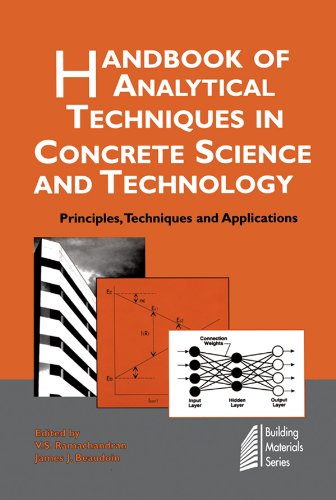
HANDBOOK OF ANALYTICAL TECHNIQUES IN CONCRETE SCIENCES AND TECHNOLOGY
PRINCIPLES, TECHNIQUES AND APPLICATIONS
BY VANGI S. RAMACHANDRAN AND JAMES J BEAUDOIN
FREE DOWNLOAD PDF
ABOUT THE BOOK
HANDBOOK OF ANALYTICAL TECHNIQUES IN CONCRETE SCIENCES AND TECHNOLOGY - PRINCIPLES, TECHNIQUES AND APPLICATIONS
AUTHORS : V.S.RAMACHANDRAN AND JAMES J BEAUDOIN
PUBLISHERS : NOYES PUBLICATIONS
Material sciences have always been a leading driver in construction innovation. This is still true today with new technologies producing new materials and advancing the performance and applications of old ones. Many issues have to be addressed and resolved before such materials are confidently accepted in practice. Issues such as durability and long-term performance, design methods to allow their integration in construction, and new or modified standards to facilitate acceptance in the marketplace are often mentioned. This book on analytical techniques in concrete science and technology is a valuable addition to the literature addressing these subjects. Over the past three decades, material scientists at IRC have contributed extensively to the advances on construction research through the development of experimental techniques. Their work is based on innovations in many areas including differential thermal methods, x-ray diffractometry, electron microscopy, petrography and design of special miniature techniques for determining mechanical behavior of cement systems. It is, therefore, natural to see that seven of the book's chapters are written by IRC scientists.
To add to this strength, the other thirteen chapters are written by world-class
experts in their respective fields. The book is the first of its kind addressing technologies associated with the use of both organic and inorganic products and composite materials. The principles of the techniques are explained and applications clearly described. In addition, a wide selection of references are provided to give the reader ready access to more detailed information should it be required.
CONTENTS
- Concrete Science
- Petrographic and Technological Methods for Evaluation of Concrete Aggregates
- Chemical Methods of Analysis of Concrete
- Thermal Analysis
- IR Spectroscopy
- Nuclear Magnetic Resonance Spectroscopy
- Scanning Electron Microscopy, X-Ray Microanalysis of Concretes
- X-Ray Diffraction
- Rheology
- Dimensional Changes
- Miniaturized Techniques
- Techniques for Corrosion Investigation in Reinforced Concrete
- Surface Area Measurements
- Pore Structure
- Silicate Polymerization Analysis
- Permeation Analysis
- NDT Techniques
- Applications of Computers and Information Technology
- Image Analysis
- Specialized Techniques
DOWNLOAD LINK : Handbook of Analytical Techniques in Concrete Sciences and Technology by V.S.Ramachandran and James J.Beaudoin Free Download PDF
DISCLAIMER : I AM NOT THE ORIGINAL PUBLISHER OF THIS BOOK ON NET. THIS BOOK'S AUTHORS HAVE ALL THE COPYRIGHTS ON IT . I AM JUST SHARING IT.
THANK YOU FOR VISITING
HOPE THIS POST IS HELPFUL TO YOU
KEEP SHARING AND HELP OTHERS !
HAVE A GREAT DAY !

CONCRETE TECHNOLOGY BY ADAM M NEVILLE AND J J BROOKS - Free Download PDF
CONCRETE TECHNOLOGY
BY ADAM M NEVILLE AND J J BROOKS
FREE DOWNLOAD PDF


ABOUT THE BOOK
CONCRETE TECHNOLOGY
AUTHORS : ADAM M NEVILLE, J J BROOKS
PUBLISHERS : PEARSON EDUCATION LIMITED
This book is aimed principally at university, college and polytechnic students who wish to understand concrete for the purpose of using it in professional practice. Because the book is written in english and beacuse it uses both SI and the so-called old Imperical units of measurement, the books is of interest and value in many countries, probably world-wide.
Concrete Technology is an all-inclusive book designed for students from British and American universities. To make a successful concrete structure, one needs to have in-depth knowledge of concrete and how it behaves under temperature, load, and humidity changes. Moreover, it is crucial to learn the basics of concrete technology and know the behavior of concrete when it is exposed to various industrial and environmental conditions. J. J. Brooks and A. M. Neville�s Concrete Technology is designed to provide a complete understanding of several aspects of concrete design and technology, right from its basic principles. The numerous topics covered in this book are concrete ingredients, properties and behavior of concrete in finished structures, concrete as a structural material, admixtures, temperature problems in concreting, strength of concrete, elasticity and creep, strength properties, testing, compliance with specifications, special concretes, permeability and durability, resistance to freezing and thawing, and relevant American and British standards.
One of the salient features of Concrete Technology is that it is a precise book consisting of limited material required by the students. It provides the condensed version of the well known properties of concrete. The authors have included many examples and problems to highlight the vital aspects of each chapter. This is a brilliant reference book for students of Structural Engineering and Civil Engineering at diploma as well as the degree level. This is also a relevant book for practicing engineers in the field. The increasing cases of failure of concrete structures in recent years clearly indicate that the professional engineer is lacking the required knowledge about concrete. It is important for an engineer to know the correct ingredients for concrete mixing to ensure the suitable mix. And, Concrete Technology is a complete book that provides that required data for working engineers.
CONTENTS
- Concrete as a Structural Material
- Cement
- Normal Aggregate
- Quality of Water
- Fresh Concrete
- Strength of Concrete
- Mixing, Handling, Placing and Compacting Concrete
- Admixtures
- Temperature Problems in Concreting
- Development of Strength
- Other Strength Properties
- Elasticity and Creep
- Deformation and Cracking Independent of Load
- Permeability and Durability
- Resistance to Freezing and Thawing
- Testing
- Compliance with Specifications
- Lightweight Concrete
- Mix Design
- Special Concretes
- An Overview
- Relevant American and British Standards
DETAILED CONTENTS


DISCLAIMER : I AM NOT THE ORIGINAL PUBLISHER OF THIS BOOK ON NET. THIS E-BOOK HAS BEEN COLLECTED FROM OTHER SITES ON INTERNET.

THANK YOU FOR VISITING MY THREAD. HOPE THIS POST IS HELPFUL TO YOU. HAVE A GREAT DAY !

Advanced Concrete Technology Constituent Materials by John Newman - Free Download PDF
Wednesday, September 9, 2015
Views:
BY Anonymous
0 COMMENTS
0 COMMENTS
ADVANCED CONCRETE TECHNOLOGY
CONSTITUENT MATERIALS
BY JOHN NEWMAN
FREE DOWNLOAD PDF


ABOUT THE BOOK
ADVANCED CONCRETE TECHNOLOGY - CONSTITUENT MATERIALS
AUTHOR : JOHN NEWMAN
PUBLISHERS : ELSEVIER BUTTERWORTH - HEINEMANN
The book is based on the syllabus and learning objectives devised by the Institute of Concrete Technology for the Advanced Concrete Technology (ACT) course. The first ACT course was held in 1968 at the Fulmer Grange Training Centre of the Cement and Concrete Association (now the British Cement Association). Following a re-organization of the BCA the course was presented at Imperial College London from 1982 to 1986 and at Nottingham University from 1996 to 2002. With advances in computer-based communications technology the traditional residential course has now been replaced in the UK by a web-based distance learning version to focus more on self-learning rather than teaching and to allow better access for participants outside the UK.
This book, as well as being a reference document in its own right, provides the core material for the new ACT course and is divided into four volumes covering the following general areas
- constituent materials
- properties and performance of concrete
- types of concrete and the associated processes, plant and techniques for its use in construction
- testing and quality control processes.
The aim is to provide readers with an in-depth knowledge of a wide variety of topics within the field of concrete technology at an advanced level. To this end, the chapters are written by acknowledged specialists in their fields. The book has taken a relatively long time to assemble in view of the many authors so the contents are a snapshot of the world of concrete within this timescale. It is the author's hope that the book will be revised at regular intervals to reflect changes in materials, techniques and standards.
CONTENTS
- Cements
- Calcium aluminate cements
- Cementitious additions
- Admixtures for concrete, mortar and grout
- Geology, aggregates and classification
- Aggregate prospecting and processing
- Lightweight aggregate manufacture
- The effects of natural aggregates on the properties of concrete
DETAILED CONTENTS


DISCLAIMER : I AM NOT THE ORIGINAL PUBLISHER OF THIS BOOK ON NET. THIS E-BOOK HAS BEEN COLLECTED FROM OTHER SITES ON INTERNET.

THANK YOU FOR VISITING MY THREAD. HOPE THIS POST IS HELPFUL TO YOU. HAVE A GREAT DAY !

Advanced Concrete Technology by Zongjin Li - Free Download PDF
ADVANCED CONCRETE TECHNOLOGY
BY ZONGJIN LI
FREE DOWNLOAD PDF


ABOUT THE BOOK
ADVANCED CONCRETE TECHNOLOGY
AUTHOR : ZONGJIN LI
PUBLISHERS : JOHN WILEY & SONS, INC.
Concrete is the most widely used material in the world. It plays an important role in infrastructure and private buildings construction. Understanding the basic behaviors of concrete is essential for civil engineering students to become civil engineering professionals. There have been some very good books regarding concrete, including Concrete by Mindess, Young, and Darwin, Concrete: Structure, Properties, and Materials by Mehta and Monteriro, and Concrete Technology by Neville and Brook. The motivation to write this book is to introduce new methodologies, new developments, and new innovations in concrete technology. The unique features of this book include the introduction of end use guided research strategy for concrete, uni?cation of materials and structures studies, and an emphasize on fundamental exploration of concrete structures, state of art of concrete development, and innovations.
This book provides more comprehensive knowledge on concrete technology, including the systematic introduction of concrete fracture mechanics and nondestructive evaluation for concrete engineering. The book is divided into nine chapters. Chapter 1 gives a brief introduction of concrete, including its historic development and advantages. Chapter 2 provides the knowledge of raw materials used for making concrete, covering aggregates, binders, admixtures, and water. Chapter 3 discusses the properties of fresh concrete, including workability and the corresponding measurement methods. Chapter 4 focuses on the structure of concrete at different scales, especially the calcium silicate hydrate at nanometer scale. Chapter 5 covers the properties of hardened concrete, including strength, durability, stress�strain relation, and dimension stability. Chapter 6 provides updated knowledge on various cement-based composites, including self-consolidation concrete, ultra-high-strength concrete, and extruded and engineered cementitious composites. Chapter 7 focuses the fracture behavior of concrete and provides the basic knowledge of fracture mechanics of concrete. Chapter 8 covers the essential knowledge of non-destructive testing of concrete engineering, including wave propagation theory in 1-D case, detecting principles of different NDT methodologies and techniques of different NDT methods. In Chapter 9, the issues regarding the future and development trend of concrete have been discussed. Although the book is designed and written primarily to meet the teaching needs for undergraduate students at senior level and graduate students at entry level, it can serve as a reference or a guide for professional engineers in their practice.
CONTENTS
- Introduction to Concrete
- Materials for Making Concrete
- Fresh Concrete
- Structure of Concrete
- Hardened Concrete
- Advanced Cementitious Composites
- Concrete Fracture Mechanics
- Non-destructive Testing in Concrete Engineering
- The Future and Development Trends of Concrete
DETAILED CONTENTS


DOWNLOAD LINK : ADVANCED CONCRETE TECHNOLOGY BY ZONGJIN LI FREE DOWNLOAD PDF
DISCLAIMER : I AM NOT THE ORIGINAL PUBLISHER OF THIS BOOK ON NET. THIS E-BOOK HAS BEEN COLLECTED FROM OTHER SOURCES OF INTERNET.

THANK YOU FOR VISITING MY THREAD. HOPE THIS POST IS HELPFUL TO YOU. HAVE A GREAT DAY !

CONCRETE ADMIXTURES HANDBOOK Properties, Science, and Technology by V.S.Ramachandran - Free Download PDF
IN
admixtures
,
concrete
,
Concrete Technology
,
Download
,
free
,
pdf
,
properties
,
ramachandran
,
Science
,
Technology
Views:
BY Anonymous
0 COMMENTS
0 COMMENTS
CONCRETE ADMIXTURES HANDBOOK
PROPERTIES, SCIENCE AND TECHNOLOGY
BY V S RAMACHANDRAN
FREE DOWNLOAD PDF


ABOUT THE BOOK
CONCRETE ADMIXTURES HANDBOOK PROPERTIES, SCIENCE AND TECHNOLOGY
AUTHOR : V S RAMACHANDRAN (Institute for Research in Construction National Research Council Canada Ottawa, Ontario, Canada)
PUBLISHERS : NOYES PUBLICATIONS
The handbook is intended for the scientist, technologist and the practitioner. It should be of use as reference material for the engineer, architect, concrete technologist, manufacturer and use of concrete and concrete admixtures. It is also intended for use by cement scientists, material scientists and students of concrete technology.
The book is divided into 10 chapters and all the important admixtures are included. Each chapter contains a list of important recent references that should be a useful guide for further reading. A chapter on �Cement Science� was included to describe the most recent concepts so that the information presented in subsequent chapters could easily be followed. The last chapter on �Patents� describes how a variety of materials (natural, synthesized or waste) can be utilized as admixtures for various purposes.
Admixtures are ingredients that are added to the concrete batch immediately before or during mixing. They confer certain beneficial effects to concrete, including enhanced frost and sulfate resistance, controlled setting and hardening, improved workability, increased strength, etc. Special concretes can be made using coloring pigments, polymer latexes, expansion or gas-producing admixtures and flocculating agents. It is estimated that 80% of concrete produced in North America contains one or more types of admixtures. Admixtures are being used increasingly in many other countries.
CONTENTS
- Concrete Science
- Research Techniques, Standards and Specifications
- Admixture Interactions in Concrete
- Chemical Admixtures-Recent Developments
- Accelerators
- Water Reducers/Retarders
- Superplasticizers
- Air-Entraining Admixtures
- Polymer-Modified Mortars and Concretes
- Mineral Admixtures
- Antifreezing Admixtures
- High-Volume Fly Ash and Slag Concrete
- Admixtures for Repair and Restoration of Concrete
- Alkali-Aggregate Expansion and Corrosion Inhibiting Admixtures
- Miscellaneous Admixtures
- Batching and Dispensing of Admixtures
- Admixture Formulations
- Admixtures For Oilwell Cements
DETAILED CONTENTS


DOWNLOAD LINK : CONCRETE ADMIXTURES HANDBOOK PROPERTIES, SCIENCE AND TECHNOLOGY BY V S RAMACHANDRAN FREE DOWNLOAD PDF
DISCLAIMER : I AM NOT THE ORIGINAL PUBLISHER OF THIS BOOK ON NET. THIS E-BOOK HAS BEEN COLLECTED FROM OTHER SOURCES OF INTERNET.

THANK YOU FOR VISITING MY THREAD. HOPE THIS POST IS HELPFUL TO YOU. HAVE A GREAT DAY !

Concrete Mix Design, Quality Control and Specification by Ken W. Day - Free Download PDF
IN
Concrete Technology
,
control
,
Download
,
free
,
ken w day
,
mix design
,
pdf
,
quality
,
specification
Views:
BY Anonymous
0 COMMENTS
0 COMMENTS
CONCRETE MIX DESIGN, QUALITY CONTROL AND SPECIFICATION
BY KEN W DAY
FREE DOWNLOAD PDF


ABOUT THE BOOK
CONCRETE MIX DESIGN, QUALITY CONTROL AND SPECIFICATION
AUTHOR : KENT W DAY
PUBLISHER : Taylor & Francis
The assumption during writing the book was that I was fully retired and might contribute further to the future of concrete technology only via this book and my website, if at all. A change arose initially from the intention of Canmet/ACI to award me recognition for my contributions to concrete quality control at their symposium in May 2006. This has led to an arrangement for me to present a whole day seminar in Silver Spring, Washington, in June 2006, under the auspices of NRMCA and others, in an attempt to bring about a change in American practice from quality control by the purchaser to control by the producer, as advocated in this book. This is very much not a handbook on how to comply with established standards but rather a view on how those standards, and other entrenched attitudes, should be revised to more nearly reflect reality and enable progress. _said by the author.
CONTENTS
- Advice to specifiers
- Properties of concrete
- Mix design
- Quality control
- Concrete in the 22nd century
- Specification of concrete quality
- Aggregates for concrete
- Cementitious and pozzolanic materials
- Chemical admixtures
- Statistical analysis
- Testing
- Unchanging concepts
- Trouble shooting
DETAILED CONTENTS


DOWNLOAD LINK : CONCRETE MIX DESIGN, QUALITY CONTROL AND SPECIFICATION BY KEN W DAY FREE DOWNLOAD PDF
DISCLAIMER : I AM NOT THE ORIGINAL PUBLISHER OF THIS BOOK ON NET. THIS E-BOOK HAS BEEN COLLECTED FROM OTHER SOURCES OF INTERNET.

THANK YOU FOR VISITING MY THREAD. HOPE THIS POST IS HELPFUL TO YOU. HAVE A GREAT DAY !

ENGINEERED CONCRETE MIX DESIGN AND TEST METHODS by IRVING KETT - Free Download PDF
IN
concrete
,
Concrete Technology
,
Download
,
engineered
,
free
,
irving
,
kett
,
methods
,
mix design
,
pdf
,
test
Views:
BY Anonymous
0 COMMENTS
0 COMMENTS
ENGINEERED CONCRETE MIX DESIGN AND TEST METHODS
BY IRVING KETT
FREE DOWNLOAD PDF


ABOUT THE BOOK
ENGINEERED CONCRETE MIX DESIGN AND TEST METHODS
AUTHOR : IRVING KETT
PUBLISHERS : Taylor & Francis Group
The purpose of this book is to familiarize civil engineering and construction technology students with two of the most important materials of construction, Portland cement (PC) and Portland cement concrete (PCC). People frequently make the error of using these terms interchangeably. It is important to keep in mind that PC is a powder, while PCC is initially a plastic material and for the remainder of its life, a solid. A valid analogy is to compare PC to flour and PCC to bread. The book aims to assist students to gain an understanding of PC and PCC through the physical handling and testing of these materials in the laboratory environment. While the book was primarily written for use at the college level, it may also serve as a practical guide for the graduate engineer and laboratory technician.
The body of this book is divided into four sections. Section 1 explains how concrete batches are designed, mixed, and measured for various consistencies, which is explained in a special chapter titled �Mix Design Procedures.� Section 2 details the tests of the primary component materials of concrete other than water� namely Portland cement, aggregates, and mortar. Section 3 includes some of the fundamental testing procedures in conformity with the standards of the American Society for Testing Materials (ASTM). Section 4 includes the various appendices, followed by an index of additional data sheets. There probably will never be enough laboratory time to complete all of the test procedures, even in a 15-week university semester.
The testing procedures included herein are intended to accurately reflect the specific ASTM designation, sometimes with modifications dictated by the inherent time constraints of an academic laboratory. In certain cases, therefore, such as in securing the specific gravities and absorption of aggregates, modifications were introduced to fit the usual 3-hour laboratory module. Where the particular ASTM method permits alternate procedures, only the one more applicable to the teaching situation was chosen.
CONTENTS
- Brief Overview of Portland Cement and Concrete Technology
- Mix Design Procedures
- Rodded Unit Weight of Coarse Aggregates
- Compressive Strength of Hydraulic Cement Mortars
- Specific Gravity and Absorption Tests of Coarse and Fine Aggregates for Use in the Design of Portland Cement Concrete Mixtures
- Resistance to Degradation of Small-Sized Coarse Aggregates by Abrasion and Impact in the Los Angeles Machine
- Dry Sieve Analysis of Fine and Coarse Aggregates
- Material Finer than 75 �m (No. 200 Sieve) by Washing
- Clay Lumps and Friable Particles in Aggregates
- Density of Hydraulic Cement
- Tensile Strength of Hydraulic Cement Mortar
- Time of Set of Hydraulic Cement by Vicat Needle
- Fineness of Portland Cement by Air Permeability Apparatus
- Sand Equivalent Value of Soils and Fine Aggregates
- Index of Aggregate Particle Shape and Texture
- Flat or Elongated Particles in Coarse Aggregate
- Standard Specifications for Wire Cloth and Sieves for Testing Purposes
- Compressive Strength of Cylindrical Concrete Specimen
- Flexural Strength of Concrete Using Simple Beam with Third-Point Loading
- Unit Weight, Yield, and Air Content of Concrete
- Slump of Hydraulic Cement Concrete
- Air Content of Freshly Mixed Concrete by the Volumetric Method
- Making and Curing Concrete Test Specimens in the Laboratory
- Air Content of Freshly Mixed Concrete by the Pressure Method
- Bond Strength of Concrete Developed with Reinforcing Steel
- Ball Penetration in Freshly Mixed Concrete
- Static Modulus of Elasticity and Poisson�s Ratio of Concrete in Compression
- Splitting Tensile Strength of Cylindrical Concrete Specimens
- Rebound Number of Hardened Concrete
- Direct Tensile Test of Portland Cement Concrete
DETAILED CONTENTS


DISCLAIMER : I AM NOT THE ORIGINAL PUBLISHER OF THIS BOOK ON NET. THIS E-BOOK HAS BEEN COLLECTED FROM OTHER SOURCES OF INTERNET.

THANK YOU FOR VISITING MY THREAD. HOPE THIS POST IS HELPFUL TO YOU. HAVE A GREAT DAY !


